Patrick Hazlewood’s imprisonment at Wormwood Scrubs
My PolicemanPatrick Hazlewood’s imprisonment at Wormwood Scrubs in February 1959 is presented as both a legal punishment and a struggle over who may speak about his relationship with Tom Burgess. Arrested on suspicion of gross indecency with Laurence Cedric Coleman, Patrick is questioned about a case he initially thinks has nothing to do with Tom. Yet the possibility that the police are also protecting or pressuring Tom enters the interrogation, making the prison narrative a record of uncertainty as well as confinement.
Arrest and the charge
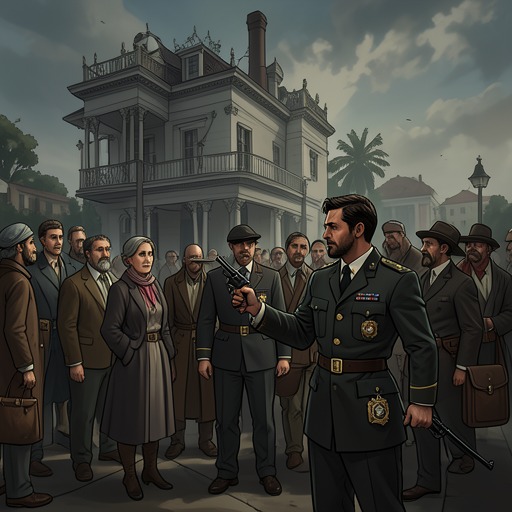
Patrick’s account places him at HMP Wormwood Scrubs in February 1959, where he writes about the arrest and the events that led there. Looking back, he lists the policeman’s knock at one in the morning, a night in the cells at Brighton Police Station, Marion Burgess’s appearance in court, and the van journey from the dock. He remembers each stage through the repeated image of a door being shut. The sequence gives imprisonment a long threshold: custody begins before the prison, and the court and transport extend the sense of being moved through a system he cannot control.
The warrant names Laurence Cedric Coleman and alleges acts of gross indecency with him. Patrick’s first response is relief, because he understands the arrest to concern the young man from the Argyle Hotel rather than Tom. That relief does not last. During questioning, Slater urges him to plead guilty and says that a plea would spare trouble not only for Patrick but for his associates. Slater invokes the harm a case could bring to family and friends. Patrick begins to wonder whether the warning is really about Tom, who is both his lover and a police colleague. The exchange does not establish what Slater intends; it shows how the threat of exposure makes even an ambiguous appeal to protect others feel dangerous.
Confinement and the act of writing
The prison account begins with Patrick’s fingers so cold that he can hold his pen for only brief intervals. He writes a few words, then pauses to warm his hands; he fears that the ink may freeze and wonders whether the cold can damage the pen. The object matters because writing is one action still available to him. He insists on setting words down even when the act is physically difficult, presenting the page as a small space of agency inside an institution defined by closed doors and restricted movement.
This makes the account more than a chronology of arrest and imprisonment. Patrick’s recollection moves between discrete public events—the police arrival, the cells, court, the van—and the immediate work of trying to write in prison. The short, accumulating sequence of words on the page contrasts with the doors that have closed behind him. He cannot reverse the arrest or control what happens to his case, but he can arrange his memories into an account. The writing does not remove the conditions of confinement; it gives them a form that can be addressed to someone beyond the prison.
Pressure, companionship, and memory
Patrick’s questioning shows how the law’s pressure reaches beyond the accused person. Slater’s reference to associates turns a guilty plea into something framed as protection for other people. Patrick fears that Tom may be among those being threatened, though the evidence in the exchange remains uncertain. Because Tom is both emotionally central to Patrick and employed within the police, the possibility of his involvement sharpens the danger of the interview without resolving whether the questioning is designed to shield or expose him.
The prison narrative also records a recurring meeting with Dr R. A. Russell. Patrick agrees to meet him once a week. The arrangement offers a contrast with the cell: Russell’s room is warm and light, and Patrick recognizes that he would rather spend time there talking than be sent back. His willingness to return gives the meetings a practical importance within the prison routine. They do not erase his confinement, but they create a recurring occasion for conversation in a setting otherwise marked by isolation and restraint.
Even while saying that he tries not to think about Tom, Patrick admits that Tom occupies most of his thoughts. Memory repeatedly returns to their time in Venice, especially a night water-taxi ride across the lagoon. In recollection, the boat’s speed, their shared laughter, and their closeness stand against the present separation. Patrick’s memories keep the relationship present, but they also intensify his suffering: the more he dwells on Tom’s sweetness, the harder it becomes to recall the obstacles that made a life together seem impossible.
Repeated telling and significance
Patrick eventually tells the men around him a story about a man who married a woman but continued to see an older man he loved. The story closely echoes Tom’s marriage and his relationship with Patrick. Patrick persists in saying that the two men loved each other, even as the group’s hostility grows and violence interrupts his telling. The scene makes speech both an act of insistence and a source of immediate risk. His repeated declaration cannot undo the prosecution or reunite the lovers, but he refuses to let the prison’s pressure make their love disappear from the story.
The account’s significance lies in this conflict between institutional custody and personal testimony. The charge identifies Patrick through an allegation; the interrogation attempts to shape his response through the threatened consequences for others; the prison setting restricts his body and access to the outside world. Against those pressures, he writes and tells a story that restores the relationship to view. Imprisonment thus becomes not only a place where Patrick is held, but the condition from which he tries to preserve a truth that the law and fear make perilous to state.